MTWAFIQ CoE: from a business challenge to a verified benefit
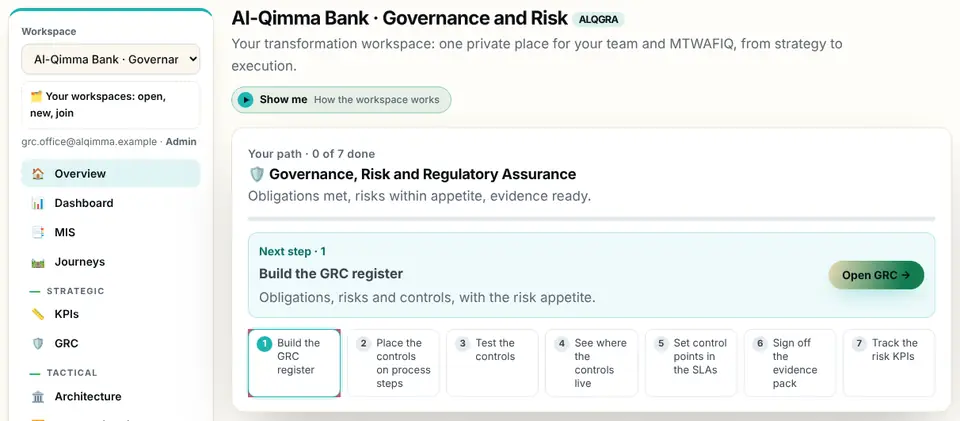
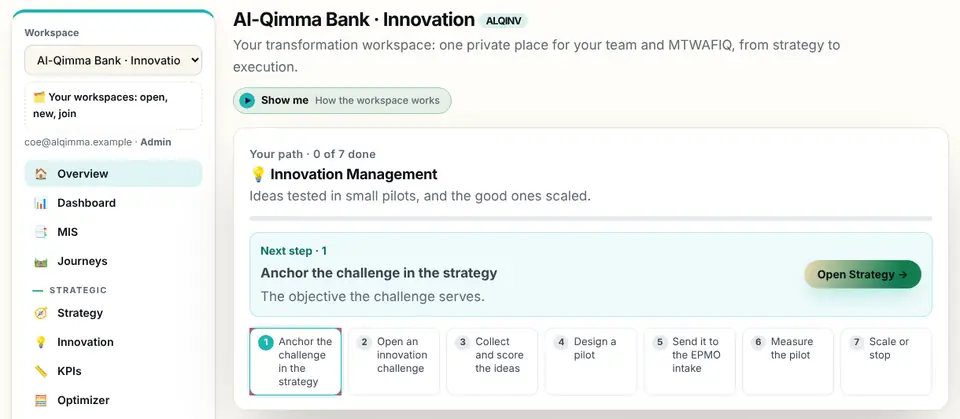
Why it existsMany transformations start well and stall in slides and email. Put the real work in one workspace, with roles, review and sign-off.
One workspace where your team works the initiative through, with roles, review and sign-off.
A note on AI. The CoE does not use AI on your work or your data. MTWAFIQ built and accelerated the platform and its reference content with AI, and no one can promise they are 100% free of errors. Check what you use against your own policies and sources before you rely on it.
Opening a current account takes 30 hours on average and 28% of applications go back to the customer for a missing document. Complaints about slow account opening reached 1,240 last quarter.
The aim
Open accounts the same working day, right first time, and prove it with measured KPIs.
The KPIs: before, target, after
Account opening lead time30 h → 6 htarget 4 h
First-time-right72% → 88%target 90%
KYC rework rate11% → 4%target 4%
Digital share of new accounts46% → 63%target 70%
The outputs, declared from the start
1
2
3
4
5
6
7
8
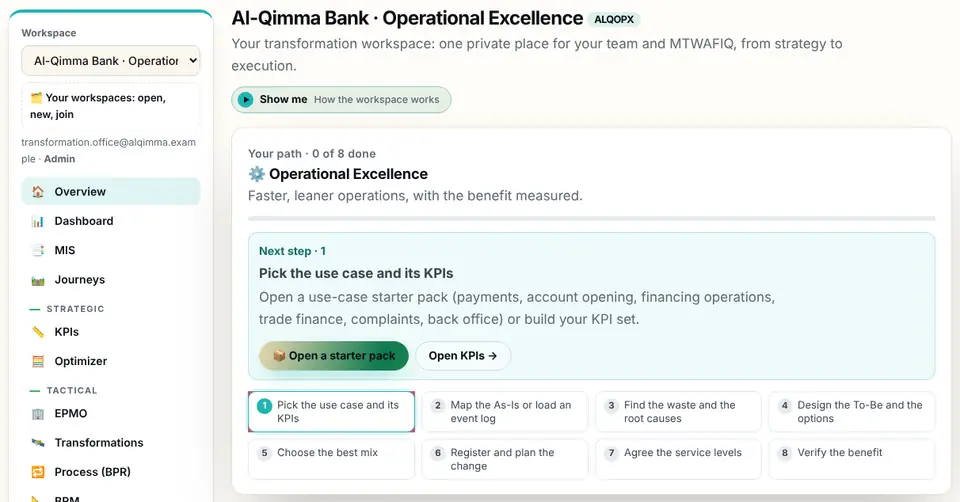
You are here · Step 1 / 8Pick the use case and its KPIs→ Output 1: KPI baseline
1
Pick the use case and its KPIs Step 1 / 8
Inputs
→
Output 1
6 account-opening KPIs with owners, measured baselines and targets
What the team did
Took the Account opening starter pack, kept its six KPIs and replaced every estimated baseline with one month of measured data.
Lead time 30 h (target 4 h) · First-time-right 72% (target 90%)
Decision for management
Approve the six KPIs, their owners and targets as the baseline of the initiative.
2
Map the As-Is or load an event log Step 2 / 8
Inputs
→
Output 2
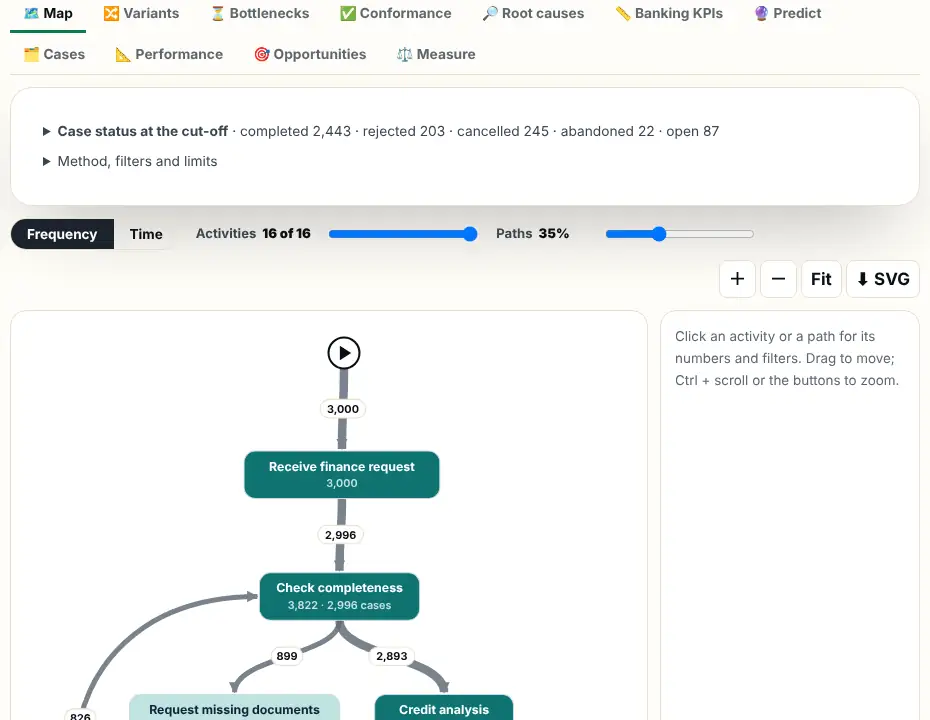
14 steps, 6 hand-offs and the real paths the cases took
What the team did
Mined the event log against the library process. Only 62% of cases followed the main path; 38% looped back to the customer at least once.
Median 30 h, of which 9 h waiting in the checker queue
3
Find the waste and the root causes Step 3 / 8
Inputs
→
Output 3
7 findings and 3 root causes, each with its evidence
What the team did
Grouped the waste: the same data keyed into three systems, documents asked for twice, and checking done in one batch at 2 pm.
Rework on 11% of files · 3 re-keys per account
Decision for management
Agree the three root causes as the scope of the redesign.
4
Design the To-Be and the options Step 4 / 8
Inputs
→
Output 4
To-Be BPMN and 3 options scored, guardrails checked
What the team did
Designed eKYC end to end, a document pre-check at first contact and continuous checking in place of the 2 pm batch.
Steps 14 → 8 · hand-offs 6 → 2
Decision for management
Approve the To-Be design within the KYC policy rules.
5
Choose the best mix Step 5 / 8
Inputs
→
Output 5
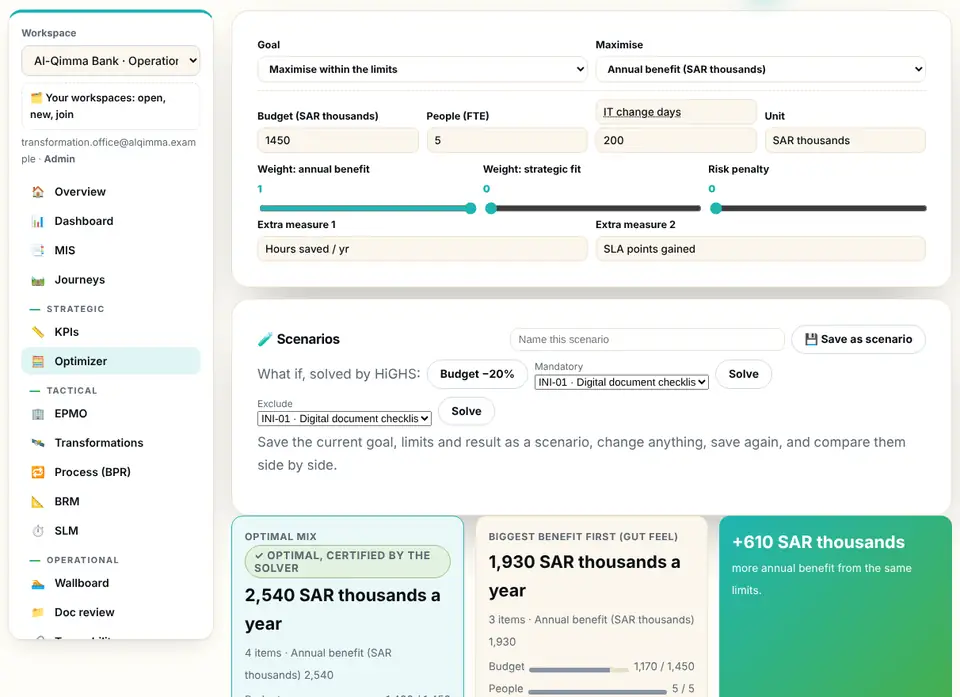
2 of the 3 options, within budget and capacity
What the team did
The Optimizer kept eKYC and the pre-check, and moved the follow-up bot to next quarter because it broke the IT capacity.
Value score 91 of 100 for SAR 3.6 m
Decision for management
Approve options A and B for SAR 3.6 m; move the follow-up bot to next quarter.
6
Register and plan the change Step 6 / 8
Inputs
→
Output 6
The decision registered, with releases, gates and owners
What the team did
Registered the decision in the EPMO; Plan It set three releases and a pilot in five branches before roll-out.
12 weeks · 3 gates · pilot in 5 branches
Decision for management
Approve the 12-week plan, its three gates and the pilot in five branches.
7
Agree the service levels Step 7 / 8
Inputs
→
Output 7
The customer promise, two internal agreements and how they are reported
What the team did
Promised the customer an active account the same working day; agreed a 2-hour OLA with the KYC checkers and 99.5% availability for the onboarding API.
SLA same day · OLA 2 h · API 99.5%
Decision for management
Sign the customer promise (same working day) and the two OLAs.
8
Verify the benefit Step 8 / 8
Inputs
→
Output 8
The KPI trend with dates and sources, signed by the sponsor
What the team did
Recorded the measured values at weeks 4 and 8 next to the baselines; the Head of Retail Operations signed the benefit.
Lead time 30 h → 6 h · First-time-right 72% → 88% · Rework 11% → 4%
Decision for management
Sign the measured benefit and keep lead time and digital share on watch.
The result
After 8 weeks, 81% of accounts open the same working day and complaints about account opening fell by two thirds.
Business case · Al-Qimma Investment · Group Strategy
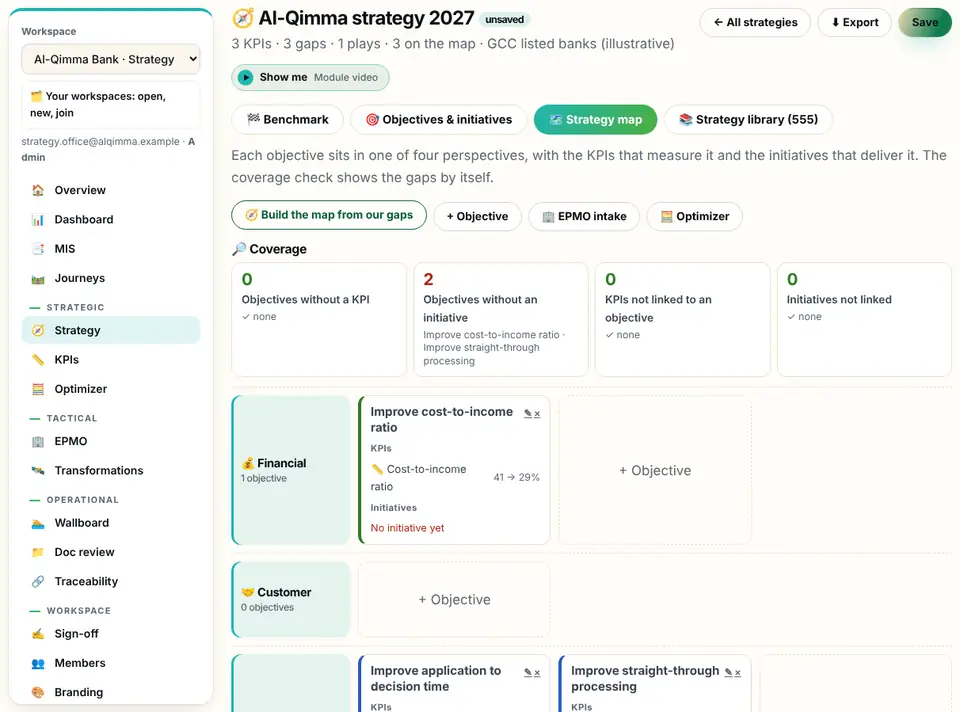
From the 3-year strategy to funded, tracked programmes
The situation
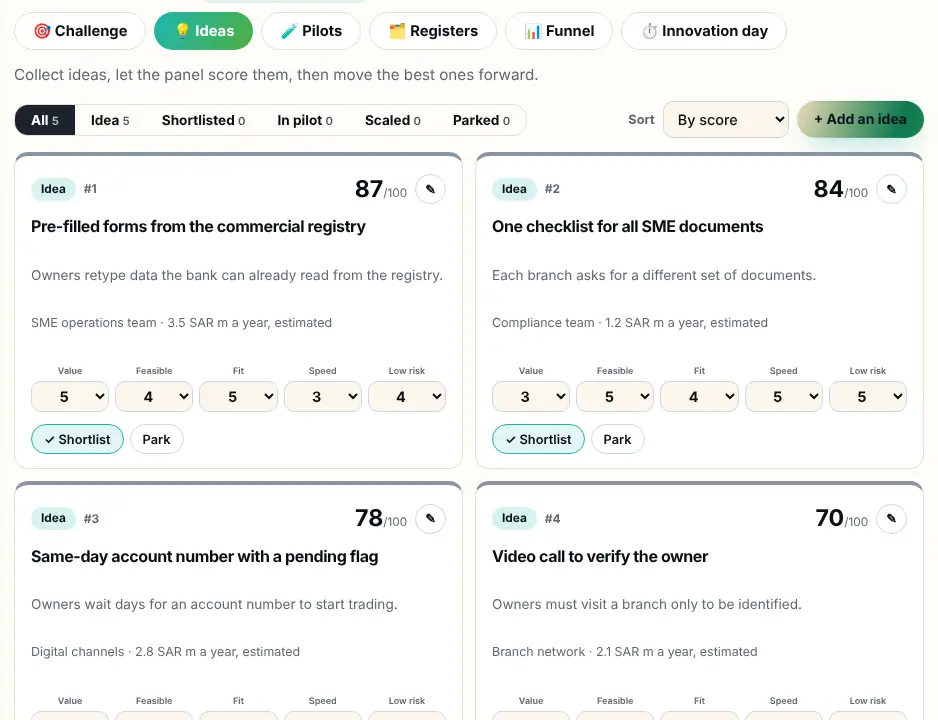
The board set a 3-year ambition to double the assets under management, but 14 initiatives competed for the same IT team and nobody could say which ones moved the strategy.
The aim
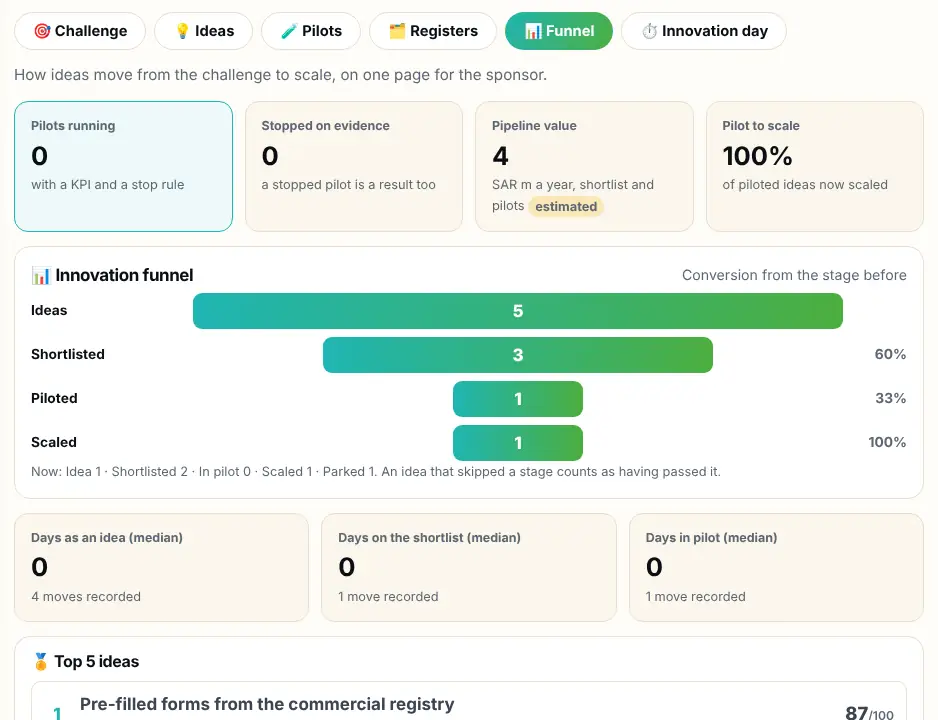
A strategy map the board can read, a funded portfolio within capacity, and benefits measured every quarter.
The KPIs: before, target, after
Digital share of fund subscriptions12% → 24%target 35%
Months to launch a new fund9 → 5target 4
Initiatives within capacity55% → 100%target 100%
The outputs, declared from the start
1
2
3
4
5
6
7
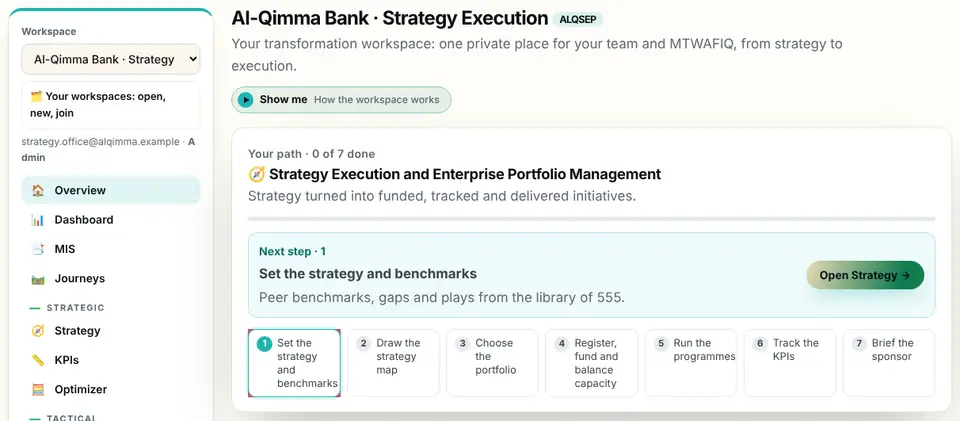
You are here · Step 1 / 7Set the strategy and benchmarks→ Output 1: Strategy brief
1
Set the strategy and benchmarks Step 1 / 7
Inputs
→
Output 1
4 themes, 6 gaps against peers and 9 candidate plays
What the team did
Benchmarked against five peers: the digital share of fund subscriptions was 12% against 35% at the best peer.
6 gaps found
Decision for management
Agree the 6 strategic gaps.
2
Draw the strategy map Step 2 / 7
Inputs
→
Output 2
12 objectives in 4 perspectives, each with a KPI and an initiative
What the team did
Linked every objective to a KPI and an initiative; three objectives had no initiative, so the gaps were visible at once.
12 objectives · 3 gaps closed
Decision for management
Approve the strategy map: 12 objectives.
3
Choose the portfolio Step 3 / 7
Inputs
→
Output 3
8 initiatives within SAR 36 m and the team's capacity
What the team did
The Optimizer dropped two large items that broke the IT capacity and kept the mix with the highest strategic value.
8 of 14 selected
Decision for management
Approve 8 of the 14 initiatives as the portfolio.
4
Register, fund and balance capacity Step 4 / 7
Inputs
→
Output 4
The 8 initiatives with budget, spend plan and capacity by unit
What the team did
Registered and funded the portfolio and moved two starts by a quarter to level the IT load.
Peak IT load 118% → 92%
Decision for management
Approve the funding and the capacity plan (peak IT load 92%).
5
Run the programmes Step 5 / 7
Inputs
→
Output 5
Workstreams, RAID logs and benefit plans
What the team did
Grouped the initiatives into Digital distribution, Product shelf and Client reporting, each with its benefit owner.
3 programmes · 11 workstreams
6
Track the KPIs Step 6 / 7
Inputs
→
Output 6
Measured values with date and source, quarter by quarter
What the team did
Recorded the first two quarters against the baselines of the strategy map.
Digital share 12% → 24% · Fund launch 9 → 5 months
Decision for management
Review the KPI trend each quarter and rebalance where a programme is off track.
7
Brief the sponsor Step 7 / 7
Inputs
→
Output 7
One page: status, decisions needed and benefits
What the team did
The CEO receives the one-page brief every Sunday and takes the decisions in the Monday committee.
1 page · every week
Decision for management
Use the one-page brief as the weekly sponsor pack.
The result
Every initiative now traces to an objective and a KPI, and the board reviews benefits measured, not reported.
About 100,000 people start a wallet sign-up every month, but only 41% finish. Most drop at the ID scan, the selfie match and the address proof, and failed scans wait 26 hours for a manual review.
The aim
Raise completion to 70% and a ready wallet in 10 minutes, without lowering the KYC standard.
The KPIs: before, target, after
Onboarding completion41% → 68%target 70%
Time to a ready wallet2,880 min → 12 mintarget 10 min
Customer satisfaction (CSAT)3.6 → 4.4target 4.5
The outputs, declared from the start
1
2
3
4
5
6
7
You are here · Step 1 / 7Blueprint the customer journey→ Output 1: Journey blueprint
1
Blueprint the customer journey Step 1 / 7
Inputs
→
Output 1
6 stages, 19 touchpoints, 4 moments that matter and 5 pain points
What the team did
Found where people leave: the ID scan (18% drop), the selfie match (9%) and the address proof (12%).
Completion 41%
Decision for management
Agree the three pain points as the scope of the onboarding change.
2
Map the processes behind it Step 2 / 7
Inputs
→
Output 2
5 back-office processes behind the 19 touchpoints
What the team did
Mapped the work behind each pain point: a failed ID scan goes to a manual queue that is checked twice a day.
Manual review 26 h on average
3
Map the systems and APIs Step 3 / 7
Inputs
→
Output 3
7 applications, 11 APIs and 2 single points of failure
What the team did
The national-ID verification API timed out at peak hours and the app had no retry, so customers started again.
Timeouts on 6% of calls at peak
4
Write the requirements Step 4 / 7
Inputs
→
Output 4
14 user stories with acceptance criteria, exported as a Jira-style CSV
What the team did
Only steps that passed the reengineering gate became stories: automatic retry, live document guidance, save and resume.
14 stories in 3 epics
Decision for management
Approve the 14 stories in 3 epics as the release scope.
5
Set the service levels Step 5 / 7
Inputs
→
Output 5
Wallet ready in 10 minutes; manual review within 2 hours; API 99.9%
What the team did
Agreed the promise with Product and Operations, and the internal agreement for the manual review queue.
Promise 10 min · review 2 h
Decision for management
Sign the 10-minute customer promise and the 2-hour review SLA.
6
Put it in the portfolio Step 6 / 7
Inputs
→
Output 6
2 releases funded, capacity balanced
What the team did
Registered the change in the EPMO with SAR 1.1 m and two squads for ten weeks.
SAR 1.1 m · 2 squads · 10 weeks
Decision for management
Fund the change: SAR 1.1 m, 2 squads, 10 weeks.
7
Verify with CX KPIs Step 7 / 7
Inputs
→
Output 7
Completion, time to wallet and CSAT, measured over time
What the team did
Recorded three measured rounds after the two releases.
Completion 41% → 68% · Time to wallet 2 days → 12 min · CSAT 3.6 → 4.4
Decision for management
Confirm the benefit and keep completion and CSAT on watch.
The result
About 27,000 more customers a month now finish onboarding, with the same KYC standard.
Business case · Al-Qimma Financing · Consumer Finance
Responsible financing, ready for the regulator's review
The situation
The regulator announced a thematic review of responsible financing in six weeks. Last year's internal audit found affordability checks overridden without approval, and complaints about unclear costs were rising.
The aim
Every obligation mapped to a tested control, the evidence signed, and the risk KPIs inside the appetite.
The KPIs: before, target, after
Controls tested effective78% → 100%target 100%
Affordability complaints per 1,000 contracts0.9 → 0.3target 0.3
Overrides without approval14 → 0target 0
The outputs, declared from the start
1
2
3
4
5
6
7
You are here · Step 1 / 7Build the GRC register→ Output 1: GRC register
1
Build the GRC register Step 1 / 7
Inputs
→
Output 1
12 obligations, 9 risks and 18 controls, with the risk appetite
What the team did
Linked every obligation to a risk and a control, and set the appetite: no tolerance for a missing affordability check.
12 obligations · 9 risks · 18 controls
Decision for management
Accept the register and the risk appetite as the basis of the review.
2
Place the controls on process steps Step 2 / 7
Inputs
→
Output 2
18 controls placed on 11 process steps
What the team did
Placed each control where the work happens and found two steps with no control: salary-verification exceptions and manual top-ups.
2 control gaps found
Decision for management
Approve closing the 2 control gaps before testing.
3
Test the controls Step 3 / 7
Inputs
→
Output 3
18 tests, each with result, evidence and approver
What the team did
Tested the 18 controls on the sample: 14 effective, 3 partly effective, 1 failed (the debt-burden ratio overridden without approval).
14 effective · 3 partial · 1 failed
Decision for management
Approve the remediation of the failed and partial controls.
4
See where the controls live Step 4 / 7
Inputs
→
Output 4
4 systems, 6 integrations and 2 manual workarounds
What the team did
Traced the failed control: the override lived in a spreadsheet outside the loan system, so no approval was ever asked.
2 manual workarounds removed
5
Set control points in the SLAs Step 5 / 7
Inputs
→
Output 5
4 control checkpoints built into the credit-operations SLA, reported monthly
What the team did
Moved the override into the loan system with a mandatory approver, and made the affordability check a checkpoint in the service levels.
4 checkpoints · monthly report
Decision for management
Sign the SLAs with the 4 control checkpoints and the monthly report.
6
Sign off the evidence pack Step 6 / 7
Inputs
→
Output 6
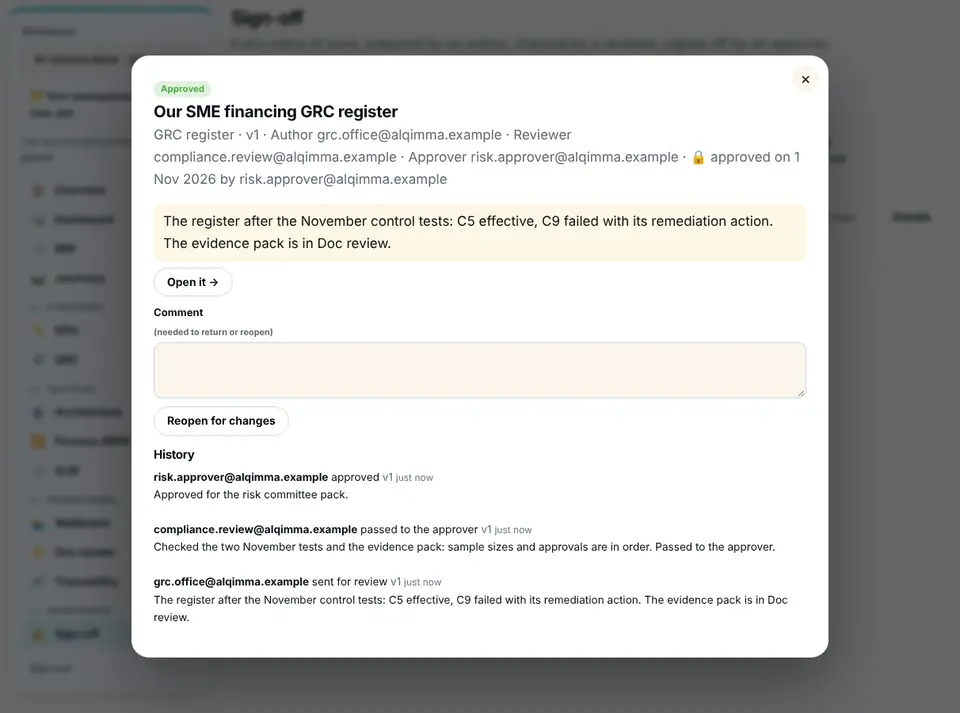
Register, tests and fixes, signed by author, reviewer and approver
What the team did
The compliance lead prepared the pack, internal audit reviewed it and the Chief Compliance Officer approved it before the review.
Signed in 9 working days
Decision for management
Sign the evidence pack for the regulator.
7
Track the risk KPIs Step 7 / 7
Inputs
→
Output 7
Control effectiveness, complaints and overrides, month by month
What the team did
Recorded three monthly rounds after the fix and shared them with the board risk committee.
Business case · Al-Qimma Financing · Collections and Customer Care
Respectful collections, every day
The situation
Collections met their targets, but complaints about tone and call times kept rising and good collectors were leaving. The values were on the wall, not in the calls.
The aim
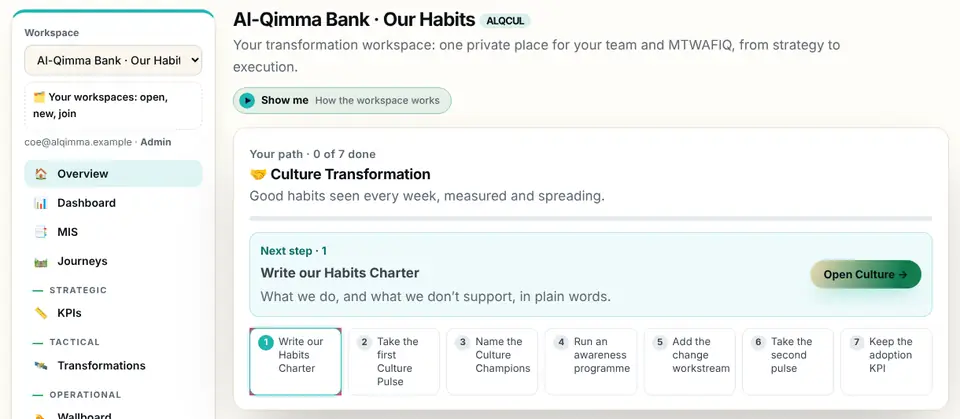
Agree the habits the team lives by, see them more often every round, and show the effect on customers and results.
The KPIs: before, target, after
Culture adoption index41 → 61target 65
Complaints per 1,000 calls3.2 → 1.4target 1.5
Promises to pay kept58% → 71%target 70%
The outputs, declared from the start
1
2
3
4
5
6
7
You are here · Step 1 / 7Write our Habits Charter→ Output 1: Our Habits Charter
1
Write our Habits Charter Step 1 / 7
Inputs
→
Output 1
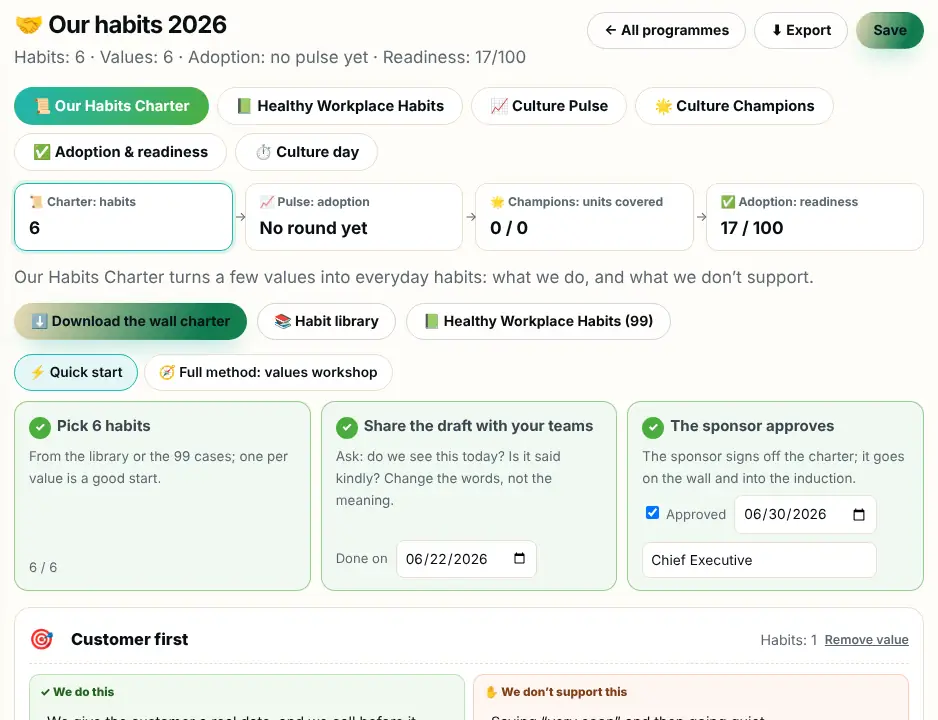
3 values and 9 habits: what we do and what we don't support
What the team did
Wrote the habits in the team's words. We do this: explain the customer's options before asking for a payment. We don't support this: calls outside the agreed hours.
3 values · 9 habits
Decision for management
Endorse Our Habits Charter: 3 values and 9 habits.
2
Take the first Culture Pulse Step 2 / 7
Inputs
→
Output 2
How often each habit is seen: the baseline
What the team did
Asked 160 staff how often they saw each habit last week.
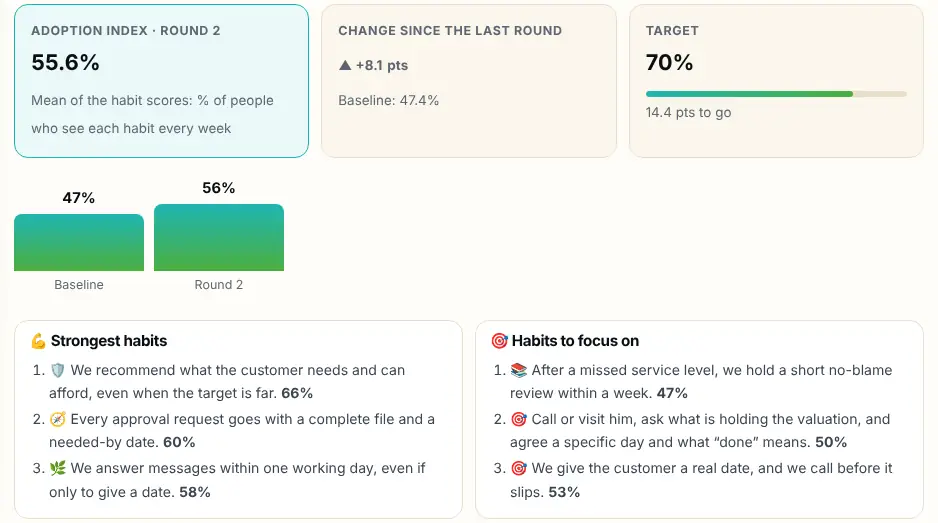
Adoption index 41
3
Name the Culture Champions Step 3 / 7
Inputs
→
Output 3
8 champions, one per team, each leading a habit
What the team did
Each champion took one of the three habits seen least often.
8 champions
Decision for management
Confirm the 8 Culture Champions and their time to lead.
4
Run an awareness programme Step 4 / 7
Inputs
→
Output 4
Healthy Workplace Habits cases and games for 160 staff
What the team did
Opened the programme by email domain; teams played the cases in their weekly huddle.
160 staff · 6 weeks
Decision for management
Approve the 6-week awareness programme for 160 staff.
5
Add the change workstream Step 5 / 7
Inputs
→
Output 5
The culture work inside the collections transformation, with milestones
What the team did
Put the habits into the call script, the quality checklist and the team leaders' coaching.
4 milestones
Decision for management
Add the change workstream and its 4 milestones to the programme.
6
Take the second pulse Step 6 / 7
Inputs
→
Output 6
Adoption compared with the baseline
What the team did
Ran the pulse again after 6 and 12 weeks.
Adoption index 41 → 52 → 61
7
Keep the adoption KPI Step 7 / 7
Inputs
→
Output 7
The adoption index with dates, next to the business results
What the team did
Kept the adoption index in the KPI history and showed it next to complaints and kept promises.
The case is a worked example on Al-Qimma, a fictional group, with illustrative figures. Your workspace is your team's own work, private to you.
How a team works
Five steps, the same in every bundle
1Diagnose
Process mining, data intelligence, benchmarking
2Decide
Options scored, then the best mix in the Optimizer
3Plan
Plan It with the critical path, the EPMO register
4Deliver
Programmes, the Wallboard, review and sign-off
5Verify
KPIs, the MIS and benefits counted only once measured
Security by design
Your data stays yours
How the CoE platform is designed for banks and regulated corporates.
🗂️Your files stay with you
Documents live in your SharePoint or Google Drive. The CoE stores links, comments and review status, never the file itself.
🧱One tenant per client
Each client has an isolated workspace, users and data. Nothing is shared between clients.
🪪Roles and access
Owner, client admin, member and viewer. Your admin decides who joins and what they can change.
🧠Built-in intelligence, no data leaves
Optimisation, simulation and analytics run inside the platform. No external AI service reads your data.
MoreLessEvery module, the live demos, the regulatory lens by region, the way to an Excellence Award, DISClock and the documents for this page
The modules behind the bundles
The activities that lead to excellence
Listed in the order a transformation runs: set up, direct, design, decide and deliver. Use one module or all of them, in your own workspace.
📁Set up
Document review room
Why it existsPolicies stall in email threads. Give every document one path: author, reviewer, named approver, and a decision on record.
Share policies, procedures and process files for review: upload the file, or link it from your own SharePoint, OneDrive or Google Drive. The CoE keeps the versions, the comments, the reviewer, the approver and the decision.
Upload the file (members only) or paste its link
Author → reviewer → named approver, each with a queue and an email
Comment threads per page or clause; approved documents locked
🧭Direct
Strategy, research & benchmarking
Why it existsStrategies stay on paper when objectives are not tied to KPIs and funded initiatives. Turn yours into a plan you can run.
Strategy refresh, market research and benchmarking against peers and reference models, turned into objectives, KPIs and an initiative portfolio you can run.
Objectives, KPIs and targets
Peer and reference-model benchmarks
Initiative portfolio and roadmap
A library of 555 strategy plays, written as practice
🛡️Direct
Governance, Risk & Compliance (GRC)
Why it existsGaps should surface before the audit, not in it. Map every obligation to its controls, owners and evidence in one register.
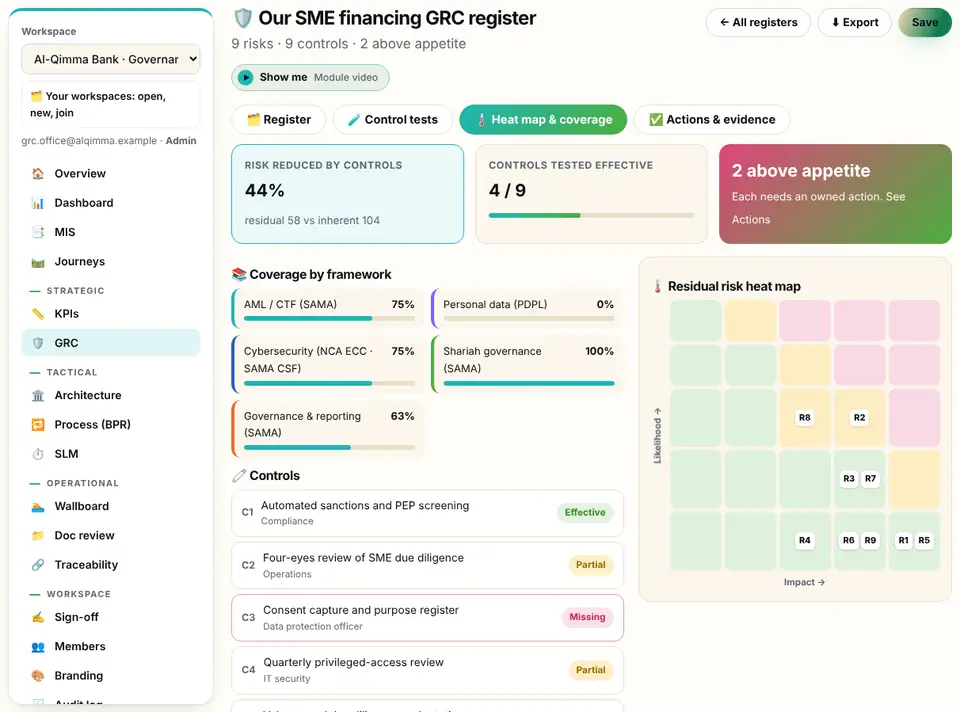
One obligations register for SAMA, NCA, PDPL, CMA and Shariah-governance requirements, mapped to the controls and process steps that meet them. Risks are scored before and after controls, controls are tested, and every gap becomes an owned action, with the evidence ready for the regulator, the auditor and the board.
Obligations → controls → process steps
Risk and control self-assessment, heat map
Gaps, owned actions and audit evidence
Regulatory flags on activities, KPIs, risks, controls and SLAs
🔁Design
Process excellence suite
Why it existsAutomating a broken process makes it fail faster. Simplify first: map, reengineer, simulate and mine before you change anything.
Process mapping As-Is and To-Be, reengineering on the MTWAFIQ 11-phase BPR method, process simulation, process mining and process intelligence. Simplify before you automate, so no broken process gets automated.
Start from 999 banking processes and 35 end-to-end journeys
As-Is and To-Be maps (BPMN 2.0)
Challenge Canvas and automation guardrails
Simulation and mining before any change
Shared team wallboard with Transformation Programs
💠Design
Customer experience (CX) design
Why it existsA better journey is not a nicer screen. Design each step down to the processes, systems and APIs behind it.
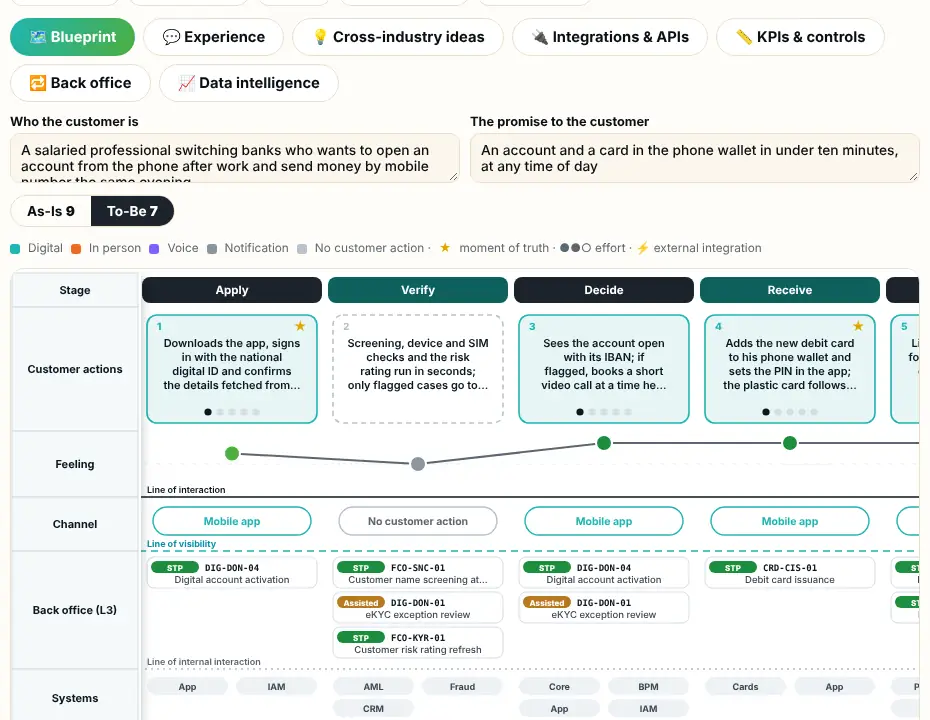
Design the customer journey down to the API. Each step, As-Is and To-Be, shows the customer and how they feel, the channel, the back-office processes, the systems and the API operations behind it. Start from 333 reference journeys in 17 domains.
333 reference journeys in 17 domains
Integrations and APIs, with OpenAPI 3.1 downloads
Back office handed to Process (BPR), requirements to BRM
Why it existsArchitecture in scattered diagrams cannot guide a change. See channels, processes, applications and APIs in one model.
The real journey across channels, processes, applications, integrations and APIs, on TOGAF's layers, BIAN's service landscape and ArchiMate. Start from the reference bank built from the MTWAFIQ database, rate your applications, and read your own BPMN, ArchiMate, draw.io, Visio and Excel files into the model.
BIAN capability map, coloured by your TIME ratings
Each journey step: process, application, API, external party
Read your diagrams in the browser: BPMN, ArchiMate, draw.io, Visio, Excel
ArchiMate export into Archi and other tools
📐Design
Business Requirements Management (BRM)
Why it existsUnclear requirements produce rework. Turn each reengineered step into a clear requirement, traced to its control and KPI.
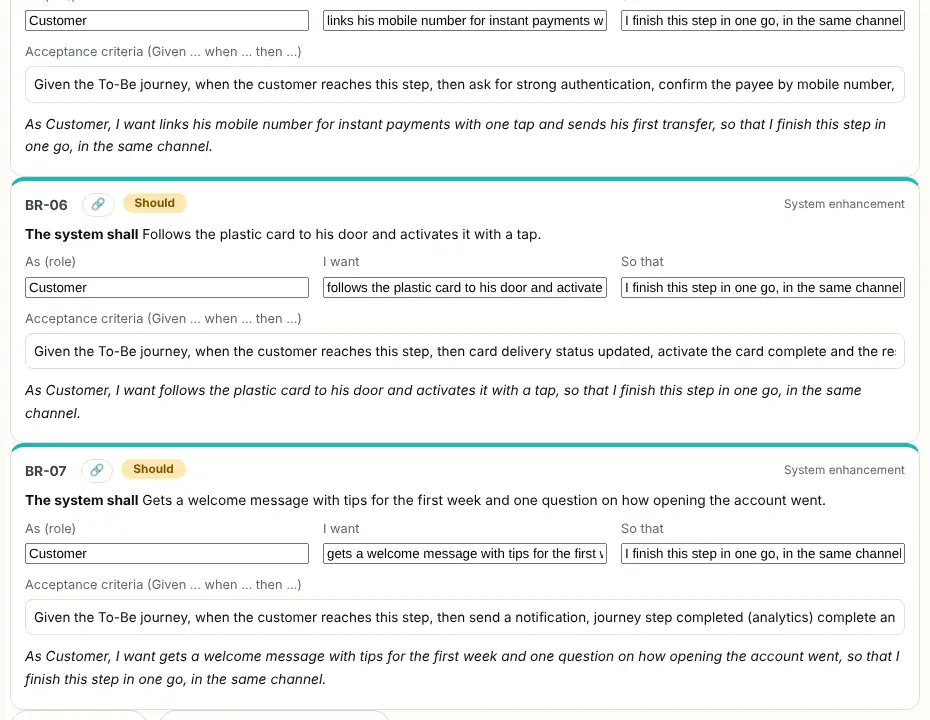
Picks up where reengineering ends. Every To-Be step that needs automation, a system change, an API integration or new development becomes a clear business requirement: user stories, acceptance criteria and priorities, traced to the process step, the control and the KPI it serves.
Fed only by steps that passed the reengineering gate
User stories, acceptance criteria, MoSCoW priority
Traceability: step → requirement → control → KPI
Start from a library process or a Customer Journey
⏱️Design
Service Level Management (SLM)
Why it existsEvery department can meet its SLA while the customer still waits. Design the end-to-end promise first, then the internal ones.
SLAs designed for the whole system, not for each department: we optimise the end-to-end promise to the customer, benchmark it against industry peers, then turn it into internal OLAs, vendor contracts and one SLA report everyone trusts.
End-to-end SLA optimised for system benefit
Benchmarking and industry peer performance review
OLAs, vendor contracts and SLA reporting
Start an SLA book from any library process
📈Decide
Data intelligence
Why it existsWithout data, every view is an opinion. Read your numbers, then confirm the reason with evidence from the work.
Show me the data, then the reason. Nine analyses Six Sigma teams use, inside Transformations, KPIs, SLM, Process and CX, written for five kinds of reader. A finding is confirmed only when evidence from the work agrees with the data.
Control charts, capability, Pareto, regression and forecast
Your own CSV or Excel data, with personal data locked out
Findings with evidence, 5 Whys and an owned action
Why it existsBudgets are often split by gut feel. Find the best mix for your budget and capacity, and see what each choice gives up.
An optimisation model that finds the best mix of processes, projects and resources for your budget, capacity and must-do rules, and shows what you give up with each choice.
Best portfolio under budget and FTE limits
Must-do and regulatory items locked in
Gut-feel vs optimal, side by side
Start from library processes or a strategy's adopted plays
🏢Deliver
Enterprise Project Management Office (EPMO)
Why it existsStatus reports stay green while delivery slips. Calculate status from the work and the spend, and turn problems into decisions.
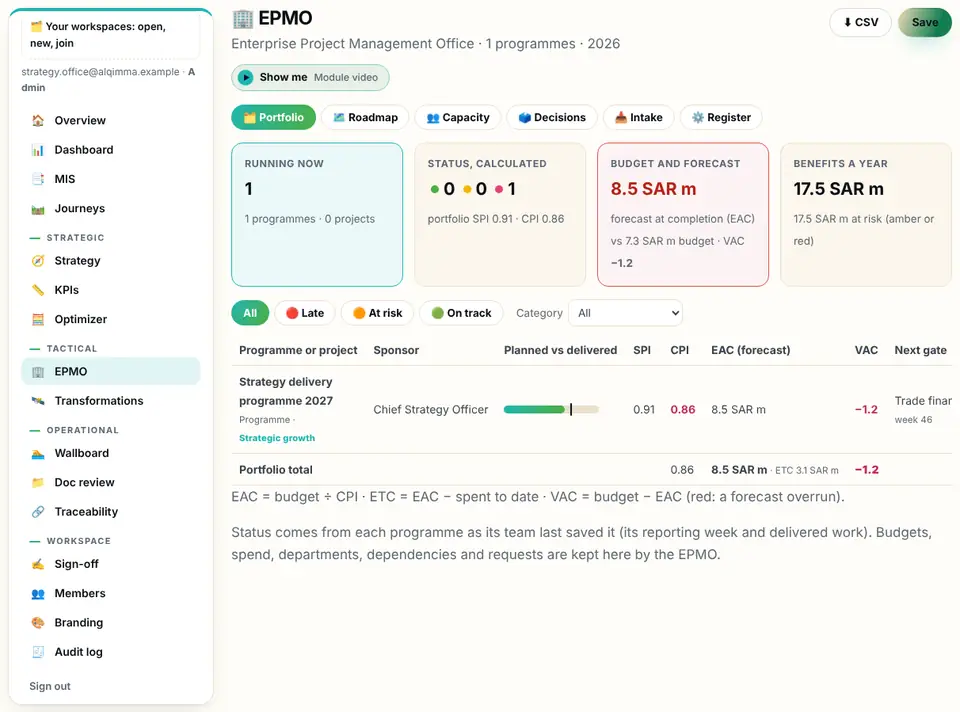
One place for every running programme and project: status calculated from planned against delivered work and budget against spend, the roadmap with its gates and dependencies, capacity by department, new requests scored and ranked, and the decisions the EPMO board must take.
Portfolio status calculated, never self-reported (SPI and CPI)
Roadmap with gates and the dependencies between projects
Capacity by department and quarter
New requests scored, ranked, then approved or parked
🛰️Deliver
Transformation Programs
Why it existsTransformations lose momentum after the launch. Keep the cadence, track the benefits and prepare the award submission with us.
We run your transformation programme remotely, with your team, across five programme types: Business Strategy, Banking Operations, Lean, Digital and Organizational Excellence. Governance, PMO cadence, risks and issues, benefits and steering packs, and the way to an Excellence Award: criteria, self-assessment, gaps, executive buy-in, training and the submission.
Five programme types, each with its frameworks and ISO standards
Self-assessment, gap analysis and the award submission
Weekly PMO rhythm, RAID log and benefits tracking
Start from the Optimizer's chosen mix
🏦Fund
SME Financing Readiness Coming soon
For small and medium businesses that need a bank or financing company to say yes. Evidence is logged and classified, readiness is scored criterion by criterion, and every deliverable is quality-scored and released only after approval. A partner licensed by the Saudi Central Bank (SAMA) then connects the file with lenders. The lender decides: MTWAFIQ does not lend, broker or promise approval.
Evidence register: every document logged and classified
QA-scored, approval-gated deliverables, sent only through a SAMA-licensed partner
Your region · GCC
Regulatory lens: Gulf frameworks
The CoE’s GRC module maps a bank's obligations from its own regulators' rules into one GRC register: controls, owners, tests and evidence. Rule texts come from the institution and official publications; nothing is pre-loaded, and no regulator approves or endorses the service.
Saudi Arabia: SAMA Cyber Security and Business Continuity frameworks, NCA Essential Cybersecurity Controls, the PDPL and the Shariah Governance Framework.
UAE: CBUAE regulations and standards on consumer protection, outsourcing and open finance, plus DFSA or FSRA rulebooks for free-zone entities.
Bahrain and Kuwait: CBB Rulebook volumes for conventional and Islamic banks, including open banking; CBK instructions and CMA rules.
Qatar and Oman: QCB data-handling and digital-bank rules; CBO's Islamic Banking Regulatory Framework, digital-bank framework and deposit protection law.
The CoE’s GRC module maps a bank's obligations from its own regulators' rules into one GRC register: controls, owners, tests and evidence. Rule texts come from the institution and official publications; nothing is pre-loaded, and no regulator approves or endorses the service.
Egypt: Law 194 of 2020 and CBE rules on capital, liquidity, governance, digital banks and eKYC; the AML law and EMLCU guidance; the Personal Data Protection Law.
Egypt's non-banks: FRA rules for consumer finance, leasing, factoring, microfinance and fintech under Law 5 of 2022.
Jordan: the Banking Law and CBJ instructions on governance, consumer protection, open finance, climate risk and Islamic-bank liquidity; AML and data-protection laws.
Morocco: Banking Law 103-12 and its 2026 reform, BAM circulars and directives, AML Law 43-05, Law 09-08 on personal data and cybersecurity Law 05-20.
The CoE’s GRC module maps a bank's obligations from the texts it is subject to into GRC: obligations, owners, controls and evidence. We build each map with you from the published rules; MTWAFIQ is not approved or recognised by any regulator and holds no pre-loaded rule library.
EU resilience and governance: DORA (ICT risk, incidents, testing, third-party register) and EBA guidelines on outsourcing and internal governance.
EU payments and financial crime: Instant Payments Regulation, PSD2 moving to PSD3/PSR, the AML Regulation and AMLA expectations.
EU prudential and conduct: CRR3/CRD6 and SREP expectations, the Consumer Credit Directive II, MiCA where relevant, and GDPR with EDPB guidance.
National layers: Germany's KWG, MaRisk and GwG with BaFin and Bundesbank expectations; France's Monetary and Financial Code with ACPR and AMF rules.
The CoE’s GRC module maps a bank's obligations from its own regulators' rules into one GRC register: obligations, controls, owners, tests and evidence. Rule texts come from the institution and official publications; nothing is pre-loaded, and no regulator approves or endorses the service.
UK: PRA Rulebook and Basel 3.1, SM&CR, operational resilience, the Consumer Duty, APP-scam reimbursement and UK GDPR.
Switzerland: the Banking Act, Capital Adequacy Ordinance, FINMA circulars, and the AML and data protection acts.
Norway: EEA versions of EU capital, payments and data rules, as applied by Finanstilsynet.
Türkiye: Banking Law 5411, Law 6493, BRSA and CBRT rules, KVKK. Ukraine: banking and payments laws, NBU rules, the AML law.
The CoE’s GRC module maps a bank's obligations from the rules its own regulators publish into GRC: obligations, owners, controls and evidence. We build each map with the institution from the source texts. MTWAFIQ is not approved or recognised by any regulator, and no rule library is pre-loaded.
US: interagency third-party risk guidance, the incident notification rule, Regulation E error resolution and BSA/AML programme duties.
New York: NYDFS Part 500 cybersecurity requirements for covered banks and licensees.
Canada: OSFI E-21, B-13 and B-10, FCAC's Financial Consumer Protection Framework, and FINTRAC obligations.
Mexico: CNBV general provisions for credit institutions, Banxico SPEI rules including the 2026 mobile-transfer guidelines, and Fintech Law duties.
Regulatory lens: Brazil, Colombia, Chile, Peru and Argentina
The CoE’s GRC module maps a bank's obligations from its own regulators' rules into one GRC register: controls, owners, tests and evidence. Rule texts come from the institution and official publications; nothing is pre-loaded, and no regulator approves or endorses the service.
Brazil: CMN and BCB rules on capital, credit loss, cyber security, PSTIs, payment institutions and Pix (incl. MED 2.0); AML Law 9,613 and COAF guidance; the LGPD.
Colombia: SFC rules including SARLAFT, Decree 368 of 2026 and Bre-B rules. Chile: CMF standards under the General Banking Law and Fintech Law, and Law 21.719 from December 2026.
Peru: SBS regulations, BCRP payment rules and Law 29733. Argentina: BCRA communications, UIF resolutions and Law 25.326.
Caribbean: ECCB rules for its eight members and local rules in Jamaica, Trinidad and Tobago, The Bahamas, Barbados and the Cayman Islands, mapped the same way.
Regulatory lens: South Africa, Nigeria, Kenya, Ghana and WAEMU
The CoE’s GRC module maps an institution's obligations from its own regulators' rules into one GRC register: controls, owners, tests and evidence. Rule texts come from the institution and official publications; nothing is pre-loaded, and no regulator approves or endorses the service.
South Africa: the Banks Act, Prudential Authority standards, FSCA conduct rules, the National Credit Act, the FIC Act and POPIA.
Nigeria: BOFIA 2020, CBN prudential, payments and non-interest rules, AML and data-protection laws and FCCPC lending rules.
Kenya: the Banking Act, CBK guidelines, AML, data and VASP laws. Ghana: Acts 930 and 987, the AML Act 2020 and the BoG cyber directive.
WAEMU: BCEAO instructions, Banking Commission circulars, the uniform AML/CFT law and national data laws; documents usually in French.
The CoE’s GRC module maps a bank's obligations from its own regulators' rules into one GRC register: controls, owners, tests and evidence. Rule texts come from the institution and official publications; nothing is pre-loaded, and no regulator approves or endorses the service.
India: RBI directions on IT governance, digital lending and payment authentication; the DPDP Act and Rules; anti-money laundering duties with FIU-IND.
Pakistan: SBP prudential and Shariah governance rules, digital-bank and payment technology-risk rules, and AML duties with the Financial Monitoring Unit.
Bangladesh: the Bank Company Act and Bangladesh Bank circulars, Money Laundering Prevention Act duties with BFIU, and the 2025 deposit and data ordinances.
Sri Lanka and Nepal: CBSL directions, the Banking (Special Provisions) Act and data law; NRB Unified Directives and AML rules under the FATF action plan.
Regulatory lens: Kazakhstan, Uzbekistan, Azerbaijan, Georgia and Kyrgyzstan
The CoE’s GRC module maps a bank's obligations from its own regulators' rules into one GRC register: controls, owners, tests and evidence. Rule texts come from the institution and official publications; nothing is pre-loaded, and no regulator approves or endorses the service.
Kazakhstan: the 2026 banking law, ARDFM prudential rules, NBK payment rules, AML and personal-data laws, and AFSA rules in the AIFC.
Uzbekistan: CBU rules, the Islamic banking law O'RQ-1126, Islamic Finance Council guidance and the Personal Data Law.
Azerbaijan and Georgia: CBAR and NBG rules, including open banking and digital-bank principles; AML and personal-data laws.
Kyrgyzstan: NBKR rules for banks, microfinance and Islamic finance windows; AML and personal-data laws.
Regulatory lens for East and Southeast Asian banks
The CoE’s GRC module maps a bank's obligations from its regulator's published rules into its GRC, with owners, controls and evidence. We build each map with your team from current texts; MTWAFIQ is not approved or recognised by any regulator.
Singapore: MAS Technology Risk Management Guidelines, outsourcing rules for banks and the Shared Responsibility Framework.
Malaysia: BNM Risk Management in Technology (RMiT), outsourcing and Shariah governance policy documents.
Hong Kong: HKMA Supervisory Policy Manual modules, including OR-2 on operational resilience, and the Cyber Resilience Assessment Framework.
Indonesia and China: OJK rules on bank IT and digital banking and Bank Indonesia payment rules; NFRA capital measures and PBOC data-security measures.
The CoE’s GRC module maps a bank's obligations from its regulators' published rules into GRC: obligation, owner, control, evidence and review date. We build the map with your team from current sources; no rule library is pre-loaded, and MTWAFIQ is not approved or recognised by any regulator.
APRA prudential standards: CPS 230 operational risk, CPS 234 information security, and capital and liquidity standards.
Accountability and conduct: Financial Accountability Regime, ASIC design and distribution obligations, responsible lending and the Banking Code of Practice.
Financial crime: AML/CTF reforms in force from 2026, and the Scams Prevention Framework codes as they are finalised.
New Zealand: RBNZ prudential requirements and Deposit Takers Act standards, the CoFI conduct regime, open banking duties and AML/CFT obligations.
All twelve services, one demo each, plus the shared team wallboard inside Process and Transformation Programs. Under each demo, “New in this service” shows the latest additions: the 999-process library, 555 strategy plays, regulatory flags, exports in your own templates and data intelligence. They run in your browser on illustrative data from the fictional Al-Qimma Bank, and you can try every module in your own free workspace.
Included in every CoE workspace · Awareness programmes
Your policies, played as well as read
Outsource your internal awareness programmes to MTWAFIQ. Your own questions, meeting cards, cases, pressure situations and behaviour cases run privately in eight MTWAFIQ games for your people, with a report of who completed. Use them for cyber security, fraud, conduct, data protection, a new policy or a new product.
Game
Your content
Opens with
Best for
🚀The Unicorn League
Questions, difficulty 1–5
25 questions
Each person climbs 25 levels, easy to hard
🎯Be Certified
Questions
10 questions
A completion check: ten in a row
⚡Speed Duel
Short questions
10 questions
Live energy in town halls and trainings
🔑Team League
Questions
10 or 25 questions
Branches and teams competing remotely
🪑Meeting Table
Cards: challenge, question, twist, role
4 cards
Team meetings and workshops
🎲Random Case
Cases with roles and a model answer
1 case
Small-group discussion
🧭Coping Skills
Pressure situations, each with a best-fit skill (Pause, Reframe, Connect or Act) and why
8 situations
Branch, operations and call-centre teams under pressure
STOP
Behaviour cases that climb from a difference to a break, four responses at each step, and what each one does to others. Pick MTWAFIQ cases or write your own
8 cases
Branches, operations, call centres and managers; completion only, never anyone’s answers
Write it, or let usFill one Excel template (Questions, Cards, Cases, Situations, STOP cases, English or Arabic), type it in your workspace, or ask MTWAFIQ to write it from your policies and load it for your review.
Open it to your peopleWorkspace members, everyone who signs in with your email domain (no invitations to send), or anyone with the programme code.
See who completedSet the completion rule (for example, 8 of 10 in a row in Be Certified) and follow players, completion and coverage of your target audience, exportable as CSV.
Your content stays private to your organisation. The Board Chairs, MTWAFIQ Future Leaders and the Flow Pool keep MTWAFIQ content.
A reference for local, regional and international Excellence Awards and the ISO standards that support them. Any of the five programme types can lead to an award, and the programme runs the nine steps with your team.
DQADubai Quality Award (DQA), part of Dubai Business Excellence AwardsUAE · Dubai
EFQM-based. The edition used in the current cycle is not confirmed, so the self-assessment uses the EFQM Model 2025.
Edition to confirmKAAKing Abdullah II Award for Excellence for the Private SectorJordan
RADAR, 1,000 points: 50% enablers, 50% results. Results points per criterion are not published.
SharjahSharjah Excellence Award (incl. Sharjah Gulf Excellence Award category)UAE; GCC for the Gulf category
Its fourth-generation model is not published, so the self-assessment uses the EFQM Model 2025.
Edition to confirmShingoShingo Model / Shingo Prize (Shingo Challenge)Global
Five maturity levels per principle; prize bands Bronze 575, Silver 675, Shingo Prize 775 of 1,000.
Nine steps to the award
Study the award and its criteriaPick the award by country and eligibility, get the licensed model, give each criterion an owner.2 to 4 weeks
Self-assessmentScore every criterion part with the award's own method, in a workshop or a simulated application.1 to 6 weeks
Gap analysis and prioritiesRank the gaps by points at stake, strategic value and effort; the top ones become workstreams.2 to 4 weeks
Start the internal transformation programmeSponsor, steering committee, PMO, criterion champions, the improvement portfolio and results measurement.2 to 4 weeks
Buy-in from every executiveEach executive owns a criterion, carries its goals in the scorecard and takes part in the assessment.2 to 6 weeks
Awareness and trainingAll staff aware, managers trained, internal assessors certified, submission writers ready.4 to 12 weeks
Prepare the award submissionCriterion by criterion responses, an evidence library and results with trends, targets and comparisons.8 to 16 weeks
Site-visit readinessA mock site visit, interview preparation and an evidence room.2 to 6 weeks
Use the feedback reportStrengths and opportunities for improvement feed the next strategy cycle.4 to 8 weeks
ISO standards that support the award criteria
ISO 9001 · Quality managementISO/IEC 27001 · Information security managementISO 22301 · Business continuity managementISO 31000 · Risk management guidelinesISO 37301 · Compliance managementISO 37001 · Anti-bribery managementISO 10002 · Complaints handlingISO 10004 · Customer satisfaction measurementISO/IEC 20000-1 · IT service managementISO/IEC 27701 · Privacy information managementISO/IEC 42001 · AI managementISO 37000 · Governance of organizationsISO 30414 · Human capital reportingISO 56001 · Innovation managementISO 56002 · Innovation management guidanceISO 18295-1 · Customer contact centresISO 22316 · Organizational resilienceISO 44001 · Collaborative business relationshipsISO 14001 · Environmental managementISO 45001 · Occupational health and safetyISO 21502 · Project, programme and portfolio managementISO/IEC 38500 · Governance of ITISO 13053-1 · Six Sigma DMAICISO 18404 · Lean Six Sigma competencies
Reference data checked on 5 October 2026 against the award bodies and iso.org. Criterion titles only; the full models are licensed by their owners. Confirm points marked "not confirmed" against the licensed model before you rely on a total. The award body decides. We prepare your team and promise no result.
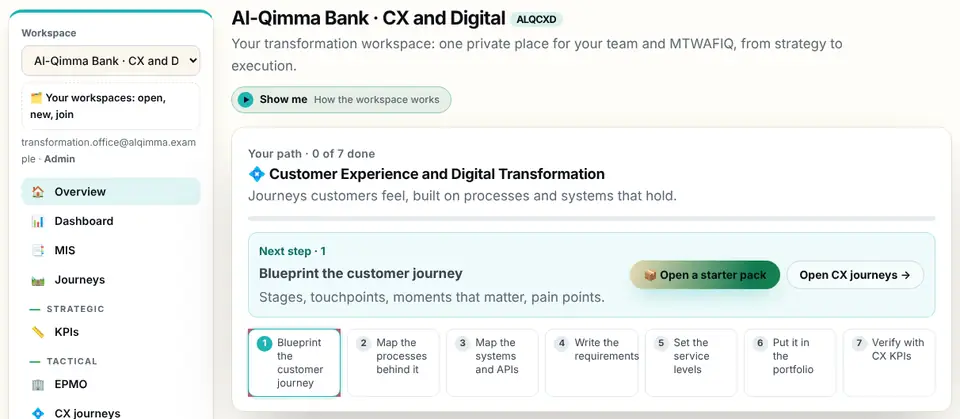
A better journey is not a nicer screen. It comes from the operations, systems and integrations behind every step. The CX module puts all of them on one blueprint, from what the customer feels to the API your IT team builds.
🗺️
Journey blueprints
Every step the customer takes, the channel, how it feels, and the back-office processes, systems and APIs behind it. As-Is and To-Be side by side.
📚
333 reference journeys
Account opening, finance, cards, trade, payments, disputes, complaints, fraud, collections, treasury, wealth and the internal and regulatory journeys, for conventional and Islamic banks.
💡
Ideas from other industries
Live tracking from food delivery, one-click checkout from e-commerce, the green lane from customs, the safety button from ride-hailing: 26 patterns that already work elsewhere, translated to banking.
🔌
Designed down to the API
An integration inventory with readiness, an API specification for every step, design controls for consent, authentication and fallbacks, and an OpenAPI file for your IT team.
Teams · Right Partner @ Right Time
DISClock: the right partner at the right time
Transformation is a team sport. DISClock puts twelve working styles on one clock, so a programme team can see who should lead a mission, who should support, and how to close the gap between two styles.
🕐
The mission card
Pick the mission and the twin on duty. The card says whether it is a good twin or a bad-luck twin, who to pair with, and what to say and avoid.
👤
Meet the twelve twins
Each working style on its own: what drives it, habits worth borrowing, what happens under pressure, and how to work with it.
🤝
Pairs, in any situation
Any two styles: what clicks, where it rubs and a tip for the pair; add a situation to see who should lead.
🏢
In every workspace
A DISClock button on every page of the CoE workspace. The mission follows the module you are in; uses are counted without names.
The team thinks on the Wallboard. Management decides on the Dashboard.
Twelve services produce a lot to know. The Dashboard reads them all and answers one question every week: what does the sponsor need to know, and what needs a decision?
🧭
Prepared by the programme manager
From each of the twelve services, pick the item and the kind of summary: the numbers, the bottom line, the story, or the cause and the plan. One dashboard per programme or per sponsor; no fixed design.
🎯
Two views of the same truth
The programme manager sees the live numbers and what changed since the last brief. The sponsor sees the brief that was published: five lines, the decisions needed and the status of each card.
🗳️
Decisions, not decoration
Late workstreams, risks above appetite, missed promises, blocked cards and integrations waiting for an agreement become decisions with an owner and a date. Record what was decided, and it leaves the list.
✉️
A one-page brief and a weekly email
Publish the week’s brief, download it as PDF, Word, PowerPoint or Excel in your own template, and email it every week to the sponsor and the people you choose in the workspace.
Data intelligence · New
Show me the data, then the reason
Without data, every view is an opinion. Data intelligence sits inside Transformations, KPIs, SLM, Process and CX as one more tab, wherever there is data to read.
📈
Nine analyses Six Sigma teams use
Run chart, control chart, bar, histogram with capability, Pareto, box plot, scatter, regression and forecast. Each one says which question it answers, when to use it and what can mislead.
👥
Written for the person reading
Five reading levels on the same chart: executive, business, analyst, Six Sigma Black Belt and data scientist. The executive sees the decision; the Black Belt sees the limits, the tests and the capability.
🔎
Data, then the reason
Data shows what happened, not why. Every chart carries the questions the data cannot answer, and a finding is confirmed only when the evidence from the work agrees, with the 5 Whys and a cause category.
🔒
Your data, with care
Analyse the live module, practice data or your own CSV or Excel file. Nothing is uploaded until you confirm there is no confidential data, and columns that look like personal data are removed before saving.
Strategy library · New
555 strategies from successful banks, fintech, financing and investment firms, and transformations
Written as practice, not theory. Patterns to test against your own numbers and market, not advice for a specific bank.
📚
555 plays in eleven families
Customer and pricing, digital and ecosystems, operations and cost, risk and capital, balance sheet and treasury, SME and corporate, Islamic banking and GCC plays, data and AI, people and culture, and transformation execution.
🧭
What really happens
Strategists do in practice what the books leave out. Every play carries that unwritten part, with the first moves, where it fits and where it does not, and the ways it usually fails.
🎯
From play to plan
Adopt a play and its KPIs join your benchmark and its first moves join your objectives, with owners and horizons. Then the initiatives compete for budget in the Optimizer and are delivered in the PMO.
In every module · New
Your reports, in your own templates
Every saved process, KPI set, risk register, SLA book, portfolio and programme becomes a document in one click. No copying into slides at midnight before the steering meeting.
📄
Pick the parts
Summary, status, objective and scope, analysis, results, next steps. Tick what the reader needs and leave out the rest.
🎨
In your own template
Your admin uploads your Word, PowerPoint and Excel templates once. Every export follows your styles, master slides and logo.
⬇
Four formats
PDF for the board pack, Word for the report, PowerPoint for the steering meeting, Excel for the analysts.
How to start
Try, open, run
1Try
Every module has a live demo on sample data from the fictional Al-Qimma Bank. No sign-in.
2Open a workspace
Sign in with a one-time code, choose the modules and invite your team, each person with a role.
3Run it
Prepare, review and sign off the work; follow it on the Dashboard and export it in your own templates.
Start with one initiative, and verify one benefit
MTWAFIQ CoE: from a business challenge to a verified benefit, in one workspace with your team.